How to keep birds away from crops: what actually works
The honest answer is that you don’t keep birds away from crops so much as reduce the damage they do — and the methods that hold up over a full season are the ones birds can’t outsmart. A scarecrow or a strip of shiny tape works for a few days until birds realize it’s harmless. The approaches that keep reducing damage month after month are physical exclusion (netting) and unpredictable bioacoustic sound systems, often used alongside good timing and habitat management. This guide walks through every common method, what it costs you in money and labor, and where it fits.
Why bird damage is worth taking seriously
Birds aren’t a nuisance at the margins — they’re a direct cost to yield and quality. According to the USDA, blackbirds alone cause roughly $150 million in agricultural damage each year, and an estimated 200 million European starlings live in North America, often forming massive flocks that descend on ripening crops. For a grower, even a few percentage points of saved fruit can cover the cost of a deterrent in the first year.
The methods, honestly compared
Netting. Physical netting is the most reliable way to exclude birds, because it’s a barrier rather than a bluff. The trade-off is cost and labor: netting is expensive to buy, time-consuming to install and remove, and prone to tearing over large acreage. It’s a strong fit for high-value, smaller plantings where the math works.
Visual deterrents. Scarecrows, reflective tape, predator-eye balloons, and flash devices are cheap and easy, and they genuinely work — for a little while. Birds habituate quickly once nothing bad actually happens, so visual scares are best as a short-term or supplementary tactic.
Propane cannons. Loud, periodic blasts can move birds early on, but the bang is predictable, so birds learn to ignore it. Cannons also generate noise complaints, and in many areas they’ve sparked neighbor disputes and even local restrictions.
Lasers. Laser deterrents can be effective in open settings, but in orchards and vineyards the beam is easily blocked by leaves and branches, and effectiveness varies by species.
Chemical and taste repellents. Sprays can reduce feeding on treated surfaces, but they wash off in rain, need reapplication, and only protect what they directly coat.
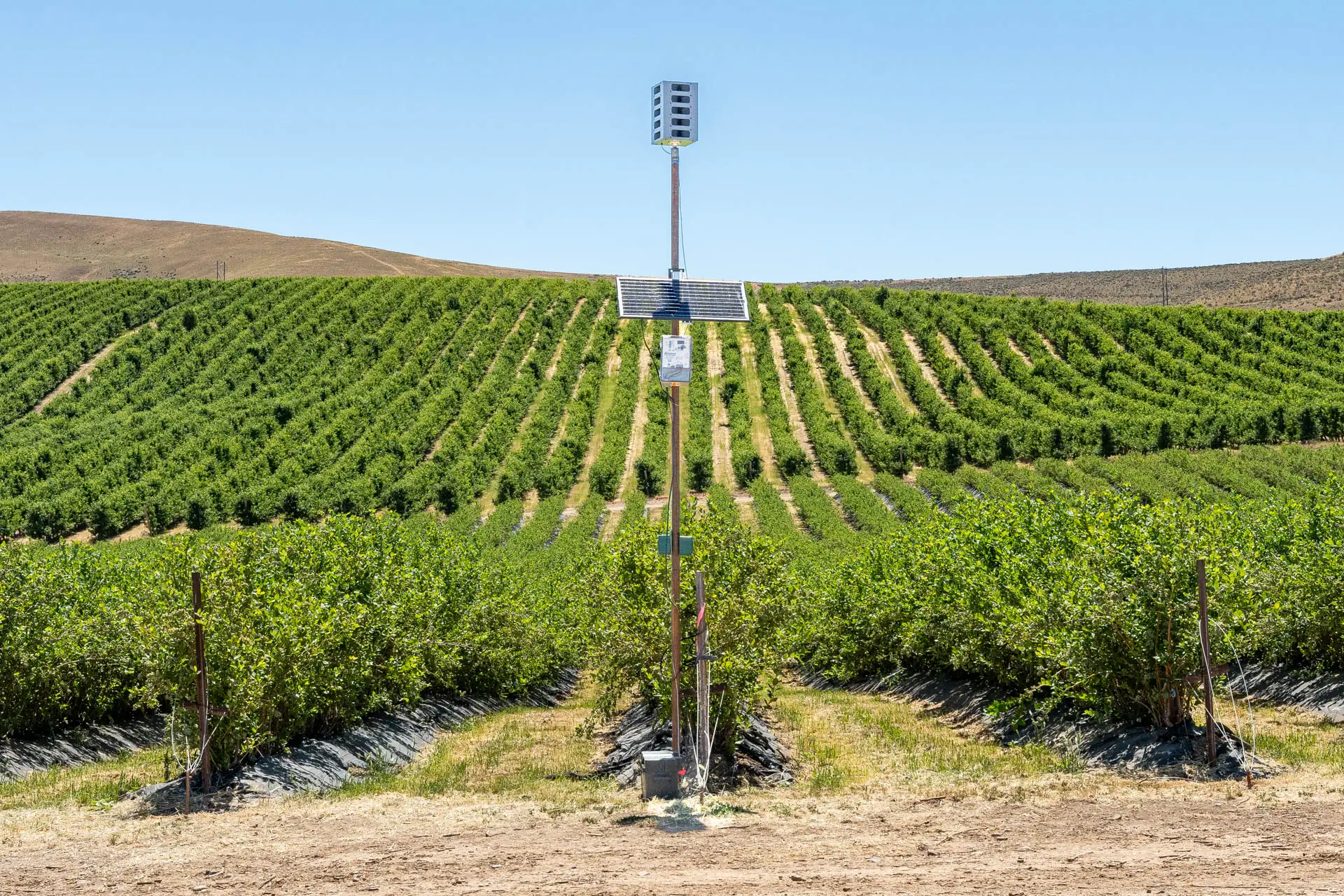
Bioacoustic sound systems. This is the method built specifically to beat the weakness of all the others: habituation. Instead of one repeated sound, a bioacoustic system plays realistic, species-specific distress calls and predator sounds in randomized patterns with quiet intervals, so birds never learn the threat is empty. Peer-reviewed research found that an unpredictable acoustic signal left far less crop damage than a constant one (Liang et al., 2024). It’s the principle behind Bird Gard’s systems, which draw on 250+ natural sounds played so there’s no pattern to learn. We cover the evidence in our guide on whether sonic bird deterrents actually work.
Why most methods fail: habituation
If you’ve tried something that worked at first and then stopped, you’ve met habituation. Birds are smart and adaptable; once they learn a scare carries no real consequence, they return. That single fact explains why scarecrows, tape, and constant noise-makers fade, and why the durable methods are either a true physical barrier (netting) or a deterrent engineered to stay unpredictable (bioacoustics). Any “set it and forget it” device that repeats the same thing on a loop will eventually be ignored.
How to choose the right approach for your crop
Match the method to the situation rather than chasing a single silver bullet. For a small, high-value block, netting may pencil out. For large acreage — vineyards, orchards, berry fields, nut crops — a bioacoustic system covers far more ground per dollar and resists habituation, which is why growers protecting vineyards, orchards, and berry crops lean on it. Many operations combine tactics: a sound system for broad coverage, plus timing harvest to limit exposure and removing nearby roosting and water sources that draw flocks in. The goal throughout is the same — reduce the damage birds do to a level that protects your harvest and your margins.
The bottom line
You can’t truly “set and forget” bird control, but you can stop wasting money on tactics birds outsmart in a week. Reliable methods are the ones that don’t depend on a bluff: physical exclusion where it’s practical, and unpredictable bioacoustic sound for the wide-area, season-long protection most growers need. If you’d like help matching a solution to your crop, acreage, and the specific birds pressuring your fields, talk to a Bird Gard advisor — there’s no cost to ask.
Ask a Bird Control Advisor, or call 541.549.0205.